Bulldog dart paper airplane
A dart with a blunt, folded-back nose: just as easy to fold, sturdier at the front, and a steady, straight flier.
- Easy
- 7 steps
- US Letter paper
- No scissors
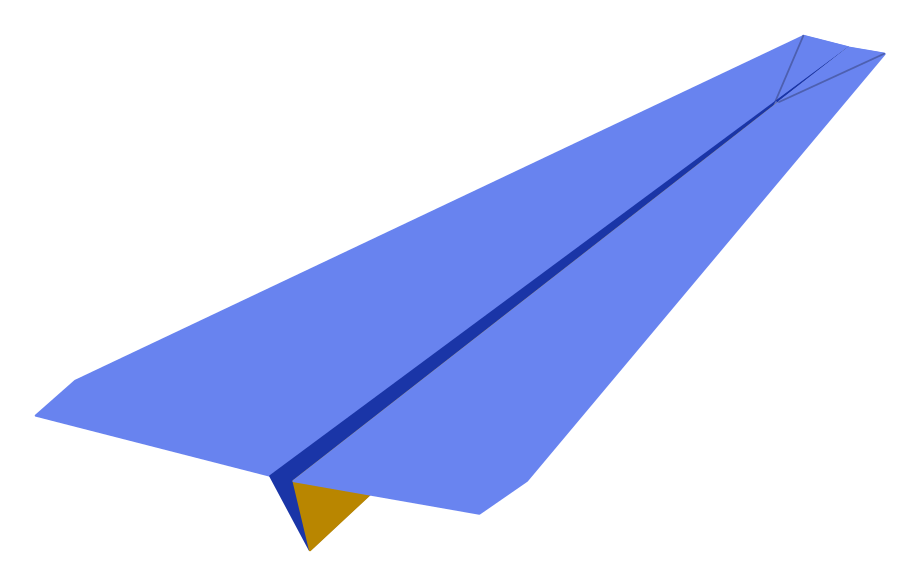
Fold it in 3D
- Yellow: the side facing up at the start
- Blue: the other side
- Dashes: fold toward you
- Dash-dot: fold away from you
Fold it, step by step
In the diagrams and the 3D model, yellow is the side of the paper facing up when you start, and blue is the other side. Any plain paper works; the colors just show which side you're looking at.
- Yellow: the side facing up at the start
- Blue: the other side
- Dashes: fold toward you
- Dash-dot: fold away from you
-
Step 1 of 7
Crease the center line
Lay the sheet flat with a short edge at the top. Fold it in half from left to right and press a sharp crease. Open it flat again.
-
Step 2 of 7
Fold the top corners to the center
Fold the top left corner down so its top edge lies along the center crease. Do the same with the top right corner. The top now comes to a point.
-
Step 3 of 7
Fold the slanted edges to the center
Fold the left slanted edge in to the center crease. Keep the point sharp. Repeat on the right. The nose is now long and narrow.
-
Step 4 of 7
Fold the point behind
Fold the pointed tip back, away from you, along a straight line across the nose about 1½ inches (4 cm) from the tip. Crease it flat behind the plane. The nose is now blunt.
-
Step 5 of 7
Fold in half
Fold the plane in half along the center crease. Fold the left half away from you, so the flaps stay on the outside and the folded tip is tucked inside.
-
Step 6 of 7
Fold the wings down
Fold the top layer down along a line from the nose, where it meets the center fold, to about 1 inch (2.5 cm) above the bottom edge at the back. Turn the plane over. Fold the other wing down to match.
-
Step 7 of 7
Open the wings
Hold the body underneath and let it open into a narrow V. Lift both wings so they stick straight out to the sides, tipped up a little. Throw it level with a smooth, medium push.
Flight log
How the Bulldog dart flies for the people who fold it. Each design shows its typical (median) flight once it has enough inside flights. Updated every night. Compare every design on the flight log.
- Median distance
- —
- Shows after 10 inside flights on 3 different days (so far 0 on 0 days)
-
- Median time aloft
- —
- Shows after 10 inside flights on 3 different days (so far 0 on 0 days)
-
- Flights logged
- 0
- Inside and outside, on this version of the fold
No flights on this version of the fold yet. Fold one, throw it and be the first to log it.
Log a flight
Folded a Bulldog dart? Throw it, then tell us how far it flew, how long it stayed up, or both. One throw at a time.
Logging a flight needs JavaScript turned on.
Tips and quick fixes
Small bends make a big difference. Change one thing, then throw again.
Why does it dive into the floor?
Bend the back edges of both wings up a little, about the thickness of a coin. That lifts the nose. Throw it level, not down.
Why does it climb, then stall?
If you bent the back edges of the wings up, flatten them. If they are already flat, bend them down a tiny bit. Throw it level and a little softer.
Why does it turn to one side?
Check that both wings are the same size and the body is straight. If it still turns left, bend the back edge of the right wing up a little. If it turns right, bend up the left one.
How is it different from the basic dart?
It folds the same way until step 4, where the sharp point is folded behind the plane. When you fold it in half, that tip ends up tucked inside the body, so the front is blunt and made of extra layers of paper instead of a single sharp point.
How far back should I fold the tip?
About 1½ inches (4 cm). A bigger fold puts more paper at the front, which makes the nose heavier: if your plane dives, try a smaller fold next time, or bend the back edges of the wings up a little.
Can I fold the tip toward me instead?
Yes, it still flies. Folding it behind is neater: the tip ends up inside the body when you fold the plane in half, so it can't open up in the air.
What paper should I use?
Plain printer paper works well. These steps use US Letter (8.5 × 11 in); A4 folds the same way and makes a slightly longer, slimmer plane.
Where it comes from
A traditional variation of the paper dart, with its point folded back to make a blunt nose; it is also called a blunt-nose or snub-nose dart. The name bulldog dart was in print by 2006, in The Dangerous Book for Boys by Conn and Hal Iggulden, which doesn't say who designed it. We found no designer credited anywhere, so we don't know who first folded it. The dart it starts from goes back to at least 1859.
Every diagram on Paper Airplane Designs is drawn by us from folding the design.