Snub-nose stunt plane paper airplane
Our own stunt plane: a dart with its long point folded down into a deep blunt nose, wings folded straight back and the back edges bent up, built to fly loops.
- Easy
- 8 steps
- US Letter paper
- No scissors
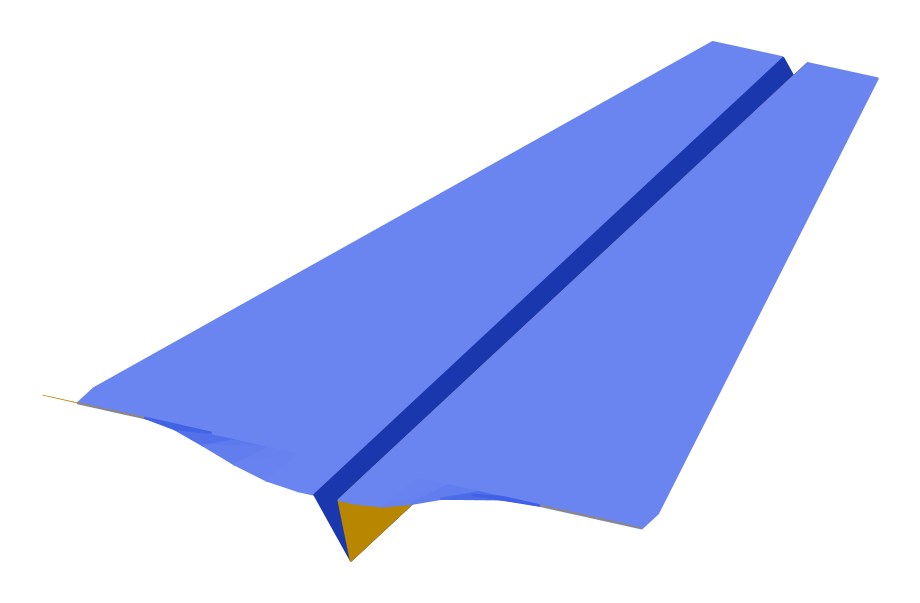
Fold it in 3D
- Yellow: the side facing up at the start
- Blue: the other side
- Dashes: fold toward you
- Dash-dot: fold away from you
- Dots: bend, don't crease
Fold it, step by step
In the diagrams and the 3D model, yellow is the side of the paper facing up when you start, and blue is the other side. Any plain paper works; the colors just show which side you're looking at.
- Yellow: the side facing up at the start
- Blue: the other side
- Dashes: fold toward you
- Dash-dot: fold away from you
- Dots: bend, don't crease
-
Step 1 of 8
Crease the center line
Lay the sheet flat with a short edge at the top. Fold it in half from left to right and press a sharp crease. Open it flat again.
-
Step 2 of 8
Fold the corners to the center
Fold the top left corner down so its top edge lies along the center crease. Do the same with the top right corner. The top now comes to a point.
-
Step 3 of 8
Fold the edges to the center
Fold the left slanted edge in so it lies along the center crease. Do the same on the right. The point is now long and narrow, like a basic dart's.
-
Step 4 of 8
Fold the point down
Fold the long point down toward you along a line straight across, 4 inches (10.2 cm) below the tip. Press it flat and hard, because it is thick here. The nose is now a flat, blunt edge, and the tip lies on the middle of the plane.
-
Step 5 of 8
Fold in half
Fold the plane in half along the center crease, folding the left half away from you, so all the folds you just made stay on the outside.
-
Step 6 of 8
Fold the wings down
Fold the top layer down along a line ¾ inch (1.9 cm) from the center fold, parallel to it, running from the nose to the back edge. Turn the plane over. Fold the other wing down to match.
-
Step 7 of 8
Open the wings
Hold the body underneath and let it open into a narrow V. Lift the wings so they stick straight out to the sides, tipped up a little.
-
Step 8 of 8
Bend up the back edges
Pinch the back edge of each wing about ½ inch (1.3 cm) in and bend that strip up about halfway, so its edge sits about ⅜ inch (1 cm) above the wing. Keep it at that height for about 1¼ inches (3.2 cm) in from the wingtip; closer to the body, let it ease back down into the wing. A light crease near the wingtip helps it hold its angle. Make both sides the same. Throw it firmly with the nose pointing up, with plenty of space in front of you.
Flight log
How the Snub-nose stunt plane flies for the people who fold it. Each design shows its typical (median) flight once it has enough inside flights. Updated every night. Compare every design on the flight log.
- Median distance
- —
- Shows after 10 inside flights on 3 different days (so far 0 on 0 days)
-
- Median time aloft
- —
- Shows after 10 inside flights on 3 different days (so far 0 on 0 days)
-
- Flights logged
- 0
- Inside and outside, on this version of the fold
No flights on this version of the fold yet. Fold one, throw it and be the first to log it.
Log a flight
Folded a Snub-nose stunt plane? Throw it, then tell us how far it flew, how long it stayed up, or both. One throw at a time.
Logging a flight needs JavaScript turned on.
Tips and quick fixes
Small bends make a big difference. Change one thing, then throw again.
Why won't it loop?
Check that the nose is folded down a full 4 inches and that both bent-up strips stand about halfway up. Throw it firmly with the nose pointing up: after a gentle throw it runs out of speed before the top. If it still only glides, bend both strips up a little more.
Why does it stall or tumble?
Most likely the strips stand up too far, or the nose isn't folded down the full 4 inches. Lower both strips a little. Strips that stand nearly straight up act like air brakes rather than lifting the nose: in our test throws, a Nakamura lock with its strips nearly straight up tumbled instead of looping.
What if it peels off to one side instead of finishing the loop?
Check first that both wings are folded down the same ¾ inch from the center fold. In our test throws it peeled off about half the time, and we think uneven wings were why; tipping the wings up into a V made little difference. Then make the two strips match exactly and keep the wings level as you let go. If it always turns the same way, raise the strip on the other side a little: if it turns left, raise the right strip; if it turns right, raise the left one.
What do the bent-up strips do?
They work like the elevators on a real airplane's tail. Air hitting the raised strips pushes the back of the plane down, which tips the nose up. With enough speed, the nose keeps coming up until the plane goes over the top and around.
Why fold the nose down so far?
A loop only works if the plane is steady, and that means its weight has to sit a little ahead of where its wings lift. Folding the long point down 4 inches packs many layers of paper into the nose and moves the weight forward. In our test throws, a stunt plane with a much lighter nose tumbled instead of looping.
How is it different from the Bulldog dart?
Both start like the Basic dart and fold the long point into a blunt nose. The Bulldog dart folds about 1½ inches of the point behind; this one folds 4 inches down in front, which packs much more paper into the nose. Its wings also fold straight back close to the center fold instead of from the point, and its back edges bend up. The Bulldog dart is built to fly straight; this one is built to loop.
What paper should I use?
Use plain printer paper. Card is too stiff to fold the thick nose neatly and makes a heavier plane that needs a faster throw. These steps use US Letter (8.5 × 11 in); A4 folds the same way and makes a slightly longer plane.
Where it comes from
Our own stunt design, drafted for this site in November 2026 after studying why paper planes loop. It starts like the traditional paper dart. Its nose is folded down like the traditional snub-nose, or bulldog, dart's, but in front and much farther; how far the nose folds, the wings folded straight back and the bent-up back edges are our choice. It looped in our test throws. The closest we found is Fold 'N Fly's Heavy-Nosed Plane, a dart whose tip is folded down and then back up again into a thick nose, which they say can loop when the nose is very heavy. Other loop planes, such as Fold 'N Fly's Loop Plane and CSIRO's loop plane, share the same idea (a heavy folded nose, a narrow body and bent-up back edges) but build their nose by folding the top edge over several times; ours builds it from the dart's long point, folded down once. We also looked through the rest of Fold 'N Fly's library and Foldable Flight's design list (its steps are videos) and found no plane folded this way. The folds are simple, so someone may well have folded it before; if you know of one, tell us and we'll credit it.
- Source: Fold 'N Fly: Heavy-Nosed Plane (the closest we found: the tip folded down, then back up and down again)
- Source: Fold 'N Fly: paper airplane library (written steps for each design)
- Source: Fold 'N Fly: Loop Plane (the same idea, with a nose made by folding the top edge over four times)
- Source: Foldable Flight: paper airplane design list (steps as videos)
- Source: CSIRO Double Helix: loop plane (the top edge folded over several times, back edges bent up)
- Source: The Public Paperfolding History Project: the paper dart (a dated history of the dart and its variants)
Every diagram on Paper Airplane Designs is drawn by us from folding the design.